
I made my first wreath for stress relief.
I was a cost engineer in oil and gas back then. Big projects, long days, a career that looked successful from the outside. But I missed creating something with my own hands. So I made a wreath. It was supposed to be simple. Something for my own front door.
Then people started asking how I made it.
That question changed everything. Not because I sold a wreath that day. Because I realized other makers needed someone to show them what was possible. What started at my kitchen island grew into DecoExchange, the How to Make Wreaths blog, and The Makers University, with a community of more than a million makers across Facebook, email, and our private spaces.
If you’re reading this, you’ve probably already had your own version of that moment. You hung something on your door, or brought a piece to a friend’s house, and someone asked if they could buy one. The hobby works. People like what you make. What nobody explains clearly is what comes next.
So let me walk you through it, the same way I had to learn it myself.
You already have the hardest part done
Most business advice starts with finding a product idea. You skipped that step. You can already make a wreath someone wants to pay for. That puts you ahead of almost everyone who wants to start a handmade business but hasn’t figured out what to make yet.
What you’re missing isn’t skill. It’s structure. A way to price your work without guessing. A way to get seen by people who aren’t already your friends and family. A system for turning interest into actual sales, over and over. A sense of what to build next instead of starting over every season.
That’s the gap between a hobby and a business. I want to name it clearly, because the wreath making world is full of tutorials on how to build a base or tie a bow, and almost empty of plain talk about pricing, marketing, and selling. I learned that the hard way, and I built everything I do now to close that gap for the next person.
From hobby to creative business
I didn’t set out to build a company. I set out to make one wreath for my own door. The business came from paying attention to what happened next, and building real structure underneath it.
That’s the same opportunity sitting in front of you right now, if your hobby has already started getting attention.
Step 1: Get sharper at the craft, on purpose
Before you sell more, tighten up what you make. Not because your wreaths aren’t good. Because consistency and speed are what let a hobby survive contact with real demand. If a custom order takes you eight hours because you’re problem-solving the design as you go, that’s a hobby pace. A business needs a process.
That’s exactly why I built HowToMakeWreaths.com. It’s free, it’s organized by skill, and it’s where I put the tutorials I wish someone had handed me early on: grapevine wreaths, deco mesh, bows, door hangers, seasonal builds.
A few good places to start:
- Grapevine wreath tutorials for the most classic, versatile base
- Mesh wreath tutorials for full, statement pieces that photograph well
- Bow making tutorials because a bow can make or break a design
- Wreath making for beginners if you want to make sure your fundamentals are solid before you build on them
I also put out a podcast, Makers Mean Business, because I never wanted to treat making and selling as two separate conversations. They’re the same conversation. I just had to learn that the slow way.
Step 2: A marketplace is a channel, not a business
Here’s something I had to learn through years of scaling DecoExchange: marketplaces are a channel, not a business. Visibility without a system is just noise. And selling isn’t the opposite of serving. It’s how your work reaches the people it was made for.
That last one took me a while to actually believe.
It’s tempting to think “get on Etsy” is the whole plan. It isn’t. An Etsy shop, a local boutique, a craft fair table, a Facebook page, these are all channels. None of them is the business. The business is the system underneath that decides what you make, how you price it, how people find out about it, and how that attention turns into a sale.
This matters because it tells you where to put your effort. Posting more on Facebook won’t fix a pricing problem. A prettier Etsy shop won’t fix a lack of repeat buyers. Each piece needs its own attention, in the right order.
Step 3: Learn the business in the order it actually works
I built The Makers University around five stages, in a specific order, because I tried to skip steps myself and paid for it:
- Identity (Design School) — build a brand, price with confidence, get clear on what you’re actually selling
- Visibility (Visibility Club) — get seen consistently instead of posting at random
- Connection (ChaChing Society) — turn that attention into a repeatable sales system
- Conversion (CMC) — build the funnels and automation that make sales less dependent on you personally
- Retention (Makers Mastermind) — scale with strategy and leadership once the core business works
Visibility without a priced, branded product is just noise. A sales system without visibility has nothing to convert. Most hobbyists trying to “figure out marketing” are actually skipping stage one and jumping straight to stage two. That’s why so much wreath marketing advice falls flat. Confidence in your product and your pricing has to come first. I learned that one the hard way too.
Design School is where I tell every new maker to start. Seven new tutorials every week. More than 2,500 tutorials on demand. Business training on pricing, marketing, and selling. A private community for real feedback. Office hours five days a week. Sixty dollars a month, cancel any time. There’s also a free workshop if you want to see how I teach before you commit to anything.
Step 4: You’re not the only one this has worked for
I hear this from makers inside Design School all the time. One member told me she used to have supplies everywhere but no confidence in what she was making, and now she can finish a piece, understand why it works, and actually feel proud enough to sell it. Another told me she used to think she had to have everything perfect before she could sell anything, until she realized she could start with one finished design and take the first real step toward getting paid for her work. One member went from $200 a month to $3,000 a month in six months, once the business side clicked for her.
That gap, between making something good and believing it’s worth selling, is the real obstacle for most hobbyists. It’s not usually a skill problem. It’s a confidence and pricing problem. That’s the exact thing Stage 1 is built to fix.
Step 5: Find your people
A wreath business gets lonely fast if you’re the only person in your house who cares whether deco mesh comes in metallic this year. I know, because that was me before any of this existed.
Our Facebook community has grown to more than 370,000 people, and most of them started exactly where you are: a hobbyist who got asked “can I buy one” and didn’t know what to do next. I check in there myself. It’s a place for real feedback from people who actually understand the craft, and a steady reminder that you’re not the first person walking this path.
If you’re newer to this corner of the craft world, come follow along on Facebook. See what an established wreath business actually looks like day to day. What gets posted, what sells, how I talk about my own work.
Step 6: Go deeper with live events, when you’re ready
Once your fundamentals are in place, get in a room with other makers. I’ve watched it happen over and over. Seeing someone else design in real time, getting feedback on the spot, being around people who take this as seriously as you do, that does something a tutorial alone can’t do.
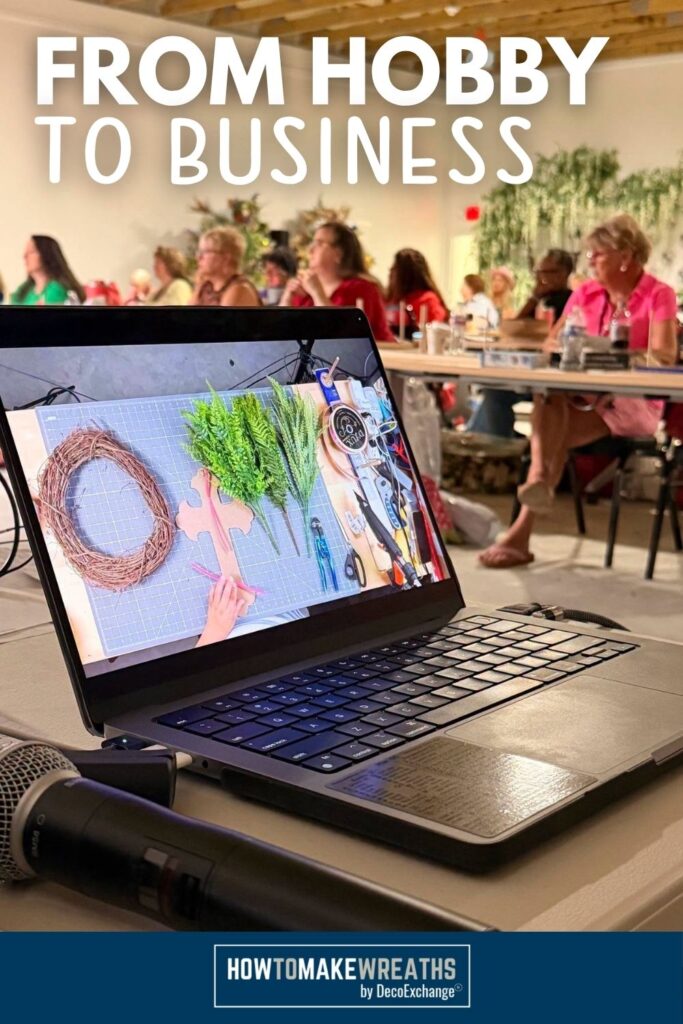
I run a calendar of live and virtual events throughout the year. Some are lower-cost virtual workshops you can join from home. This year, I opened up my classroom in Lacassine, Louisiana, for a small group of makers, with live demonstrations, business sessions, and real time with me and my coaches. Check that page directly for what’s currently open, since I add and update events as the year goes on. But the pattern stays the same: there’s usually a lower-cost way in, and a deeper, in-person option for the makers who are ready to go all in.
The order I’d follow, if I were starting today
If you take nothing else from this, take the order:
- Tighten your craft until your process is repeatable, not improvised. HowToMakeWreaths.com is built for exactly this.
- Get clear on your brand and pricing before you worry about marketing. This is Stage 1, and it’s the stage most hobbyists skip.
- Build visibility on purpose, not at random, once you actually have something priced and ready to sell.
- Build a sales system so your income doesn’t depend on you remembering to post.
- Find your community for feedback and accountability. You don’t have to figure this out alone. I didn’t either.
- Get in a room once you’re serious enough to want people around you who take this as seriously as you do.
If you’re ready to stop guessing and actually build something, come start in Design School. I built it for the maker who knows there’s more possible but doesn’t want to figure it all out alone. Come watch a free class first if you want to see what it’s like before you commit to anything. Either way, I’d love to have you in the room.

